How Much Does It Cost to Build a Dock?
It’s one of the first questions every waterfront property owner asks, and one of the hardest to answer without more information. Dock construction costs on the Louisiana and Mississippi Gulf Coast vary considerably, and the range is wide enough that general estimates from the internet are often misleading or outright useless.
The honest answer is that dock cost depends on a combination of factors specific to your property: water depth, bottom conditions, dock length and width, materials, features like boat lifts and electrical service, and the permitting requirements in your location. A basic residential pier in favorable conditions and a feature-rich covered dock with a boat lift and shore power are both “docks,” but they’re priced completely differently.
This guide breaks down each cost factor so you understand what drives the number on your proposal, and what choices you can make to manage cost without compromising on what matters.
How Much Does It Cost to Build a Dock?
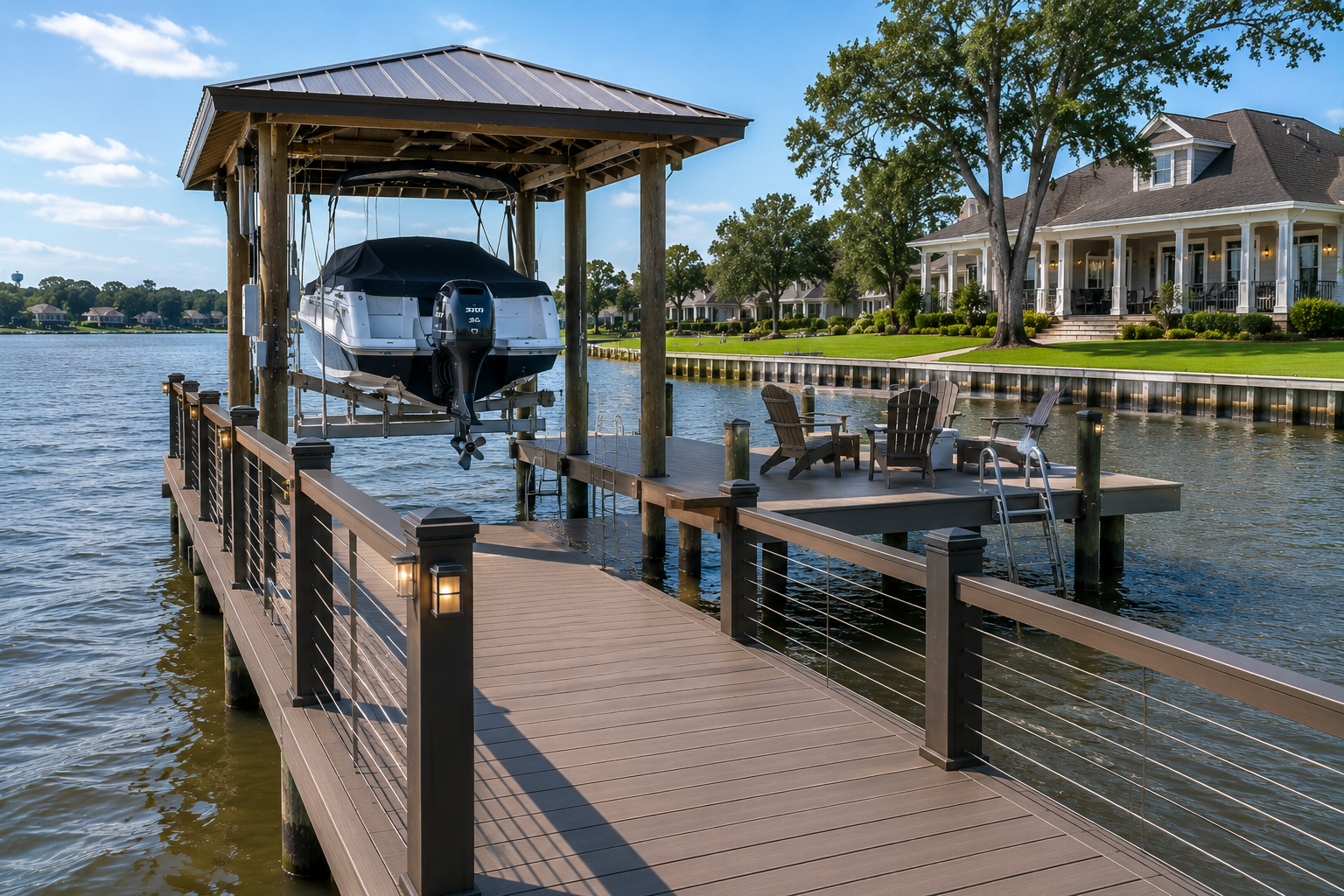
A basic residential dock on the Louisiana or Mississippi Gulf Coast typically starts in the range of $15,000 to $30,000 for a straightforward fixed pier with treated lumber decking, standard railings, and basic hardware. Mid-range projects with composite decking, aluminum railings, electrical service, and a boat lift commonly run $40,000 to $80,000. Large or complex docks with covered sections, boathouse structures, multiple boat slips, and premium materials can reach $100,000 or more.
These ranges are starting points, not quotes. The only reliable number for your project comes from a site assessment and a detailed proposal from an experienced Gulf Coast dock builder.
Cost Factor 1: Dock Length and Width
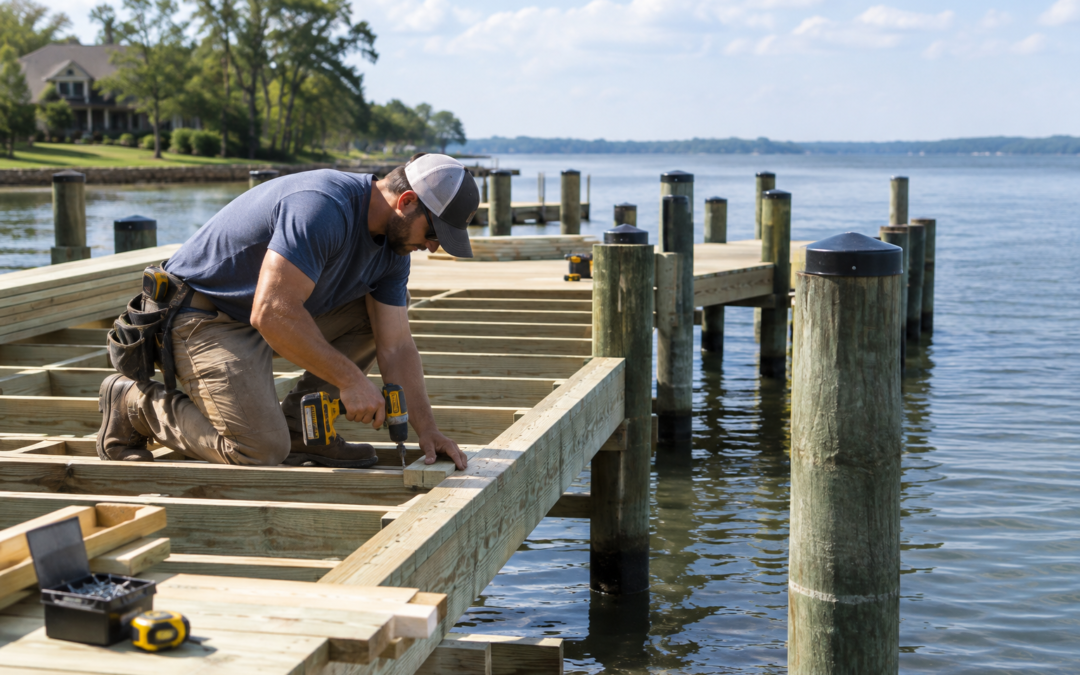
Length is the most direct driver of dock cost. Every additional linear foot of dock requires more pilings, more framing lumber, and more decking. For a fixed piling dock, each bay of framing (typically six to eight feet of length) requires at least one new piling set, the associated framing members, and the decking to cover it.
Width adds cost in a similar way. A four-foot-wide access pier uses half the decking and framing of an eight-foot-wide dock with the same length. Wider dock sections are popular for entertaining areas and platform sections at the end, but those wider bays add meaningfully to the overall cost.
T-head and L-head configurations, which add a perpendicular platform at the dock’s end, are common on the Gulf Coast and add significant square footage, and therefore cost, over a simple linear walkway.
Cost Factor 2: Water Depth and Bottom Conditions
Water depth affects how long the pilings need to be. In deeper water, pilings must be longer to achieve the required embedment depth while still reaching the intended deck height above the waterline. Longer pilings cost more and take more time to drive.
Bottom composition is just as important as depth. In the soft, silty soils common to Louisiana’s coastal waterways, pilings often need to be driven significantly deeper than standard tables suggest to achieve adequate bearing capacity. Some sites require helical pile anchors (https://lamulle.com/helical-piles/) or other specialty foundation approaches when conventional driven piles won’t hold. Difficult bottom conditions add to both material and labor costs.
A site assessment by an experienced contractor is the only way to understand how bottom conditions at your specific location will affect your project cost.
Cost Factor 3: Decking Material
The choice of decking material has a significant impact on both upfront cost and long-term economics. The main options are:
- Pressure-treated lumber is the most economical upfront choice. Standard ACQ or CA-treated lumber performs well as dock decking in most Gulf Coast applications. Expect to budget for periodic inspection, replacement of damaged boards, and some staining or sealing over time.
- Composite decking carries a higher per-board-foot cost, typically 50 to 100 percent more than treated lumber depending on the product. However, composite boards require almost no maintenance, don’t splinter in bare feet, and hold their appearance much better under Louisiana sun and heat. For most property owners planning to keep their dock for ten or more years, composite decking is worth the upfront premium.
- Tropical hardwoods and other premium options are available at higher price points and offer excellent durability but limited practical advantage over quality composite products in most applications.
Cost Factor 4: Pilings
Pilings are the foundation of the dock, and their cost depends on type, diameter, length, and the number required. Common piling materials for Gulf Coast residential docks include:
- Round creosote-treated timber pilings are traditional, cost-effective, and proven in Louisiana coastal environments. They remain the most common piling choice for residential dock construction on the north shore.
- CCA-treated pine pilings are a common alternative where creosote restrictions apply. They perform comparably to creosote timber in most residential applications.
- Composite pilings offer corrosion and marine borer resistance without the chemical treatment questions. They carry a higher upfront cost but may have a longer service life in some environments.
Piling spacing, which is determined by load requirements and the span capacity of the framing system, determines how many pilings your dock needs. More pilings mean higher material and installation cost.
Cost Factor 5: Features and Accessories
The features you add to your dock are often where the cost difference between a basic dock and a full-featured one becomes most significant:
- Boat lifts are one of the largest add-on costs. A residential boat lift (https://lamulle.com/boat-lift-installation/) ranges from roughly $5,000 to $20,000 or more depending on capacity, type, and installation complexity. This cost is on top of the dock structure itself.
- Electrical service, including shore power for boats and dock lighting, adds $2,000 to $6,000 or more depending on the service level and the length of the conduit run from the property.
- Covered sections and boathouse structures add significantly to project cost but provide protection for your boat and create a premium waterfront feature. A covered boathouse at the end of a pier is a separate structural element with its own engineering and material costs.
- Railings, cleats, fish cleaning stations, rod holders, and other accessories add incrementally. Aluminum railing systems hold up better on the Gulf Coast than wood and carry a moderate cost premium over basic treated lumber railings.
Cost Factor 6: Permitting
Permitting costs are often overlooked in early budgeting conversations. State and federal permits for dock construction on Gulf Coast waterways involve application fees, and in some cases environmental review or mitigation costs. Permit preparation and management by your contractor is also a service that carries a cost.
Budget $500 to $2,500 or more for permitting-related expenses depending on your location and project complexity. Projects in environmentally sensitive areas or navigable waterways may have additional requirements that add to this cost.
Cost Factor 7: Site Access and Logistics
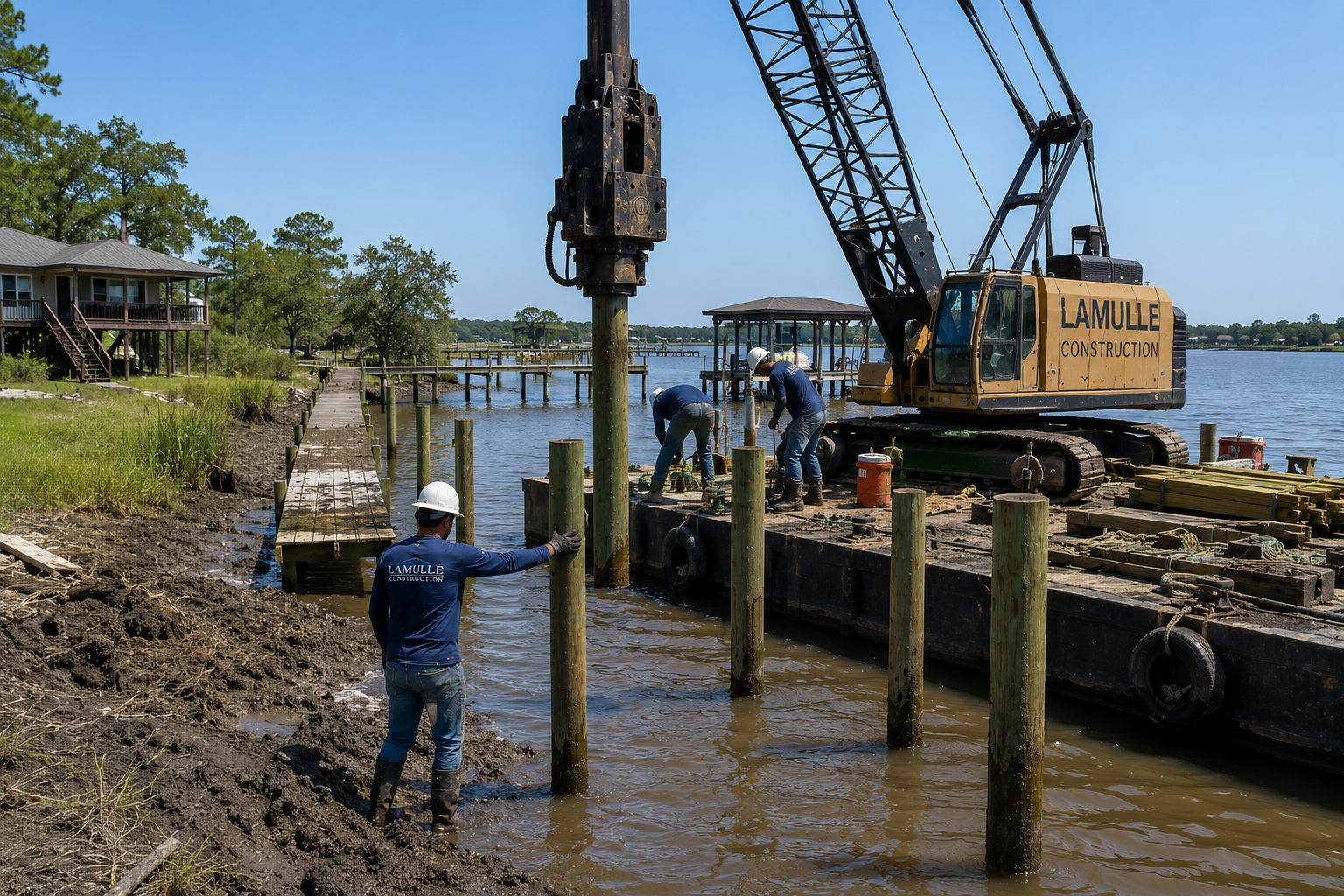
Some properties have excellent construction access: a clear waterfront with easy equipment staging, direct water access for a barge-mounted pile driver, and minimal obstructions. Others present significant logistical challenges that add cost: overgrown shorelines, tight lot lines, difficult water access, or distant equipment staging areas.
These logistics factors are real cost drivers that a contractor will account for when they assess your site. They’re also one of the reasons why a site visit is required before any meaningful cost estimate can be developed.
What You Can Do to Manage Dock Construction Cost
If budget is a constraint, there are ways to manage cost without sacrificing structural integrity:
- Limit the footprint. A shorter or narrower dock costs less. Identify what you actually need functionally and design to that, rather than building for a scenario you may never encounter.
- Phase the project. Build the structural dock now and add boat lift, electrical service, or covered sections later. The pilings and framing can be designed to accommodate future additions even if they’re not installed on day one.
- Choose materials strategically. Treated lumber decking is a legitimate cost saver if you’re willing to accept the maintenance trade-off. Composite on high-traffic areas and treated lumber elsewhere is a hybrid approach some property owners use.
- Plan permitting early. Permit delays cost money in extended project timelines and contractor scheduling gaps. Starting the permit application process well ahead of your target start date is one of the most effective ways to keep a project on schedule and on budget.