The Bogue Falaya is not a river that announces itself from the road. It slips through Covington beneath a canopy of hardwoods and cypress, widening and narrowing on its way toward the Tchefuncte and eventually Lake Pontchartrain, and the people who live along it tend to measure their days by the water: a kayak slid in before the heat settles, a small boat tied off for an afternoon of fishing, a quiet evening on a deck suspended just above the current.
A dock is what turns that proximity into daily use, but building one on a river is a fundamentally different undertaking from building one on an open lake. Lake docks mostly contend with wind, waves, and a fairly predictable water line, whereas a river dock has to cope with a surface that rises and falls with rain that may have fallen miles upstream, a steady current that leans on every piling, and the branches and logs that high water sends downstream. A design copied from a lakefront neighbor can look sensible on paper and still fail its first serious flood.
Lamulle Construction has built waterfront structures across the Lake Pontchartrain region since the company was founded post-WWII by EJ Lamulle, and David and John Lamulle carry that work forward today. This guide explains what Covington property owners should understand before planning a dock on the Bogue Falaya, from choosing a dock type to navigating permits and hiring the right builder.
What Should Property Owners Know Before Building a Dock on the Bogue Falaya?
Building a dock on the Bogue Falaya requires planning for river conditions that differ from Lake Pontchartrain: fluctuating water levels, current, floating debris, and flood events. Property owners should choose a dock type suited to those conditions, use marine grade materials, and secure the right federal, state, and parish permits before construction begins.
Each of those points shapes the design in ways that are easy to overlook if you are used to lake or canal construction, so the sections below take them one at a time and explain what a well built riverfront dock does differently.
How the Bogue Falaya Differs From Lake Pontchartrain
The most important difference is that a river’s water level is not set by wind and tide alone. Rain that falls well upstream eventually reaches your bank, which means the surface in front of your property can sit comfortably low through a dry stretch and then rise by several feet within a few days of a heavy storm. A dock has to remain usable and structurally sound across that entire range, and a design proportioned for the average water level may be unreachable at low water or half submerged at high water.
Current is the second difference, and it works on a dock in two ways. The steady push of moving water leans against every piling and framing member, so a river dock needs bracing in the direction of flow that a still water dock can skip. The water also carries debris, from small branches to full logs after a major storm, and each of those objects is a potential impact against the structure.
Flooding is the third, and it is the factor that most often decides whether a dock lasts for decades or needs rebuilding after a single event. The rivers around Covington can rise quickly after heavy rain, and a dock that was not designed with that possibility in mind can be overtopped, lifted, or battered by debris at the moment it is most exposed. Decisions about deck height, connection strength, and whether to build a fixed or floating structure all trace back to this risk.
Finally, the bank itself deserves attention. Many properties along the Bogue Falaya sit on steep, shaded, or soft banks where roots and saturated soil are doing much of the work of holding the ground in place. The point where the dock meets the shore must be designed so that it neither undermines that bank nor settles away from it over time, and that detail is easy to get wrong when all the attention is on the structure over the water.
Choosing Between Fixed, Floating, and Hybrid Docks
No single dock type is right for every riverfront lot. The best choice depends on how far the water level at your property actually swings, how you plan to use the dock, and how much flood exposure the site carries. The table below summarizes how the main options compare, and the paragraphs that follow explain the reasoning.
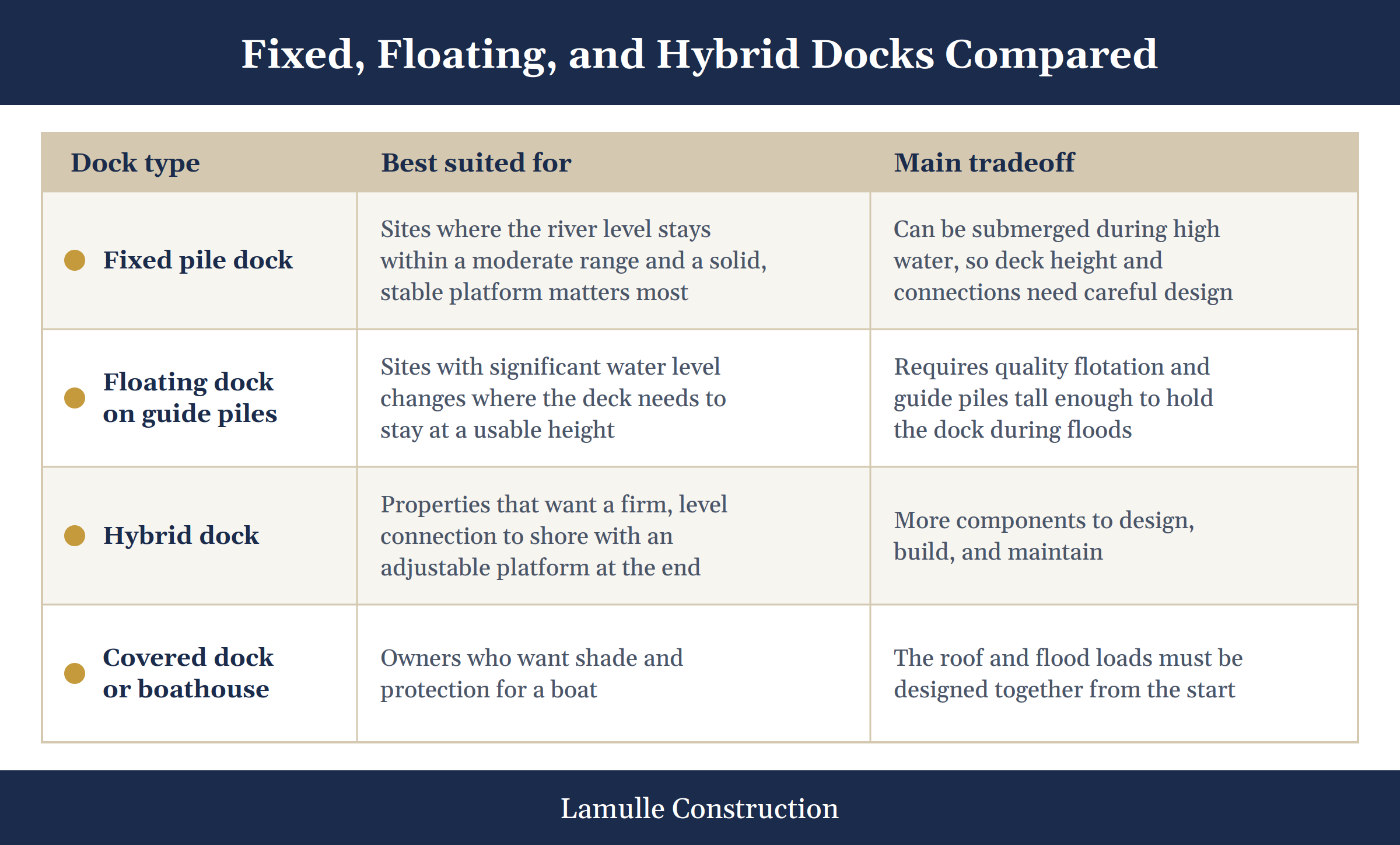
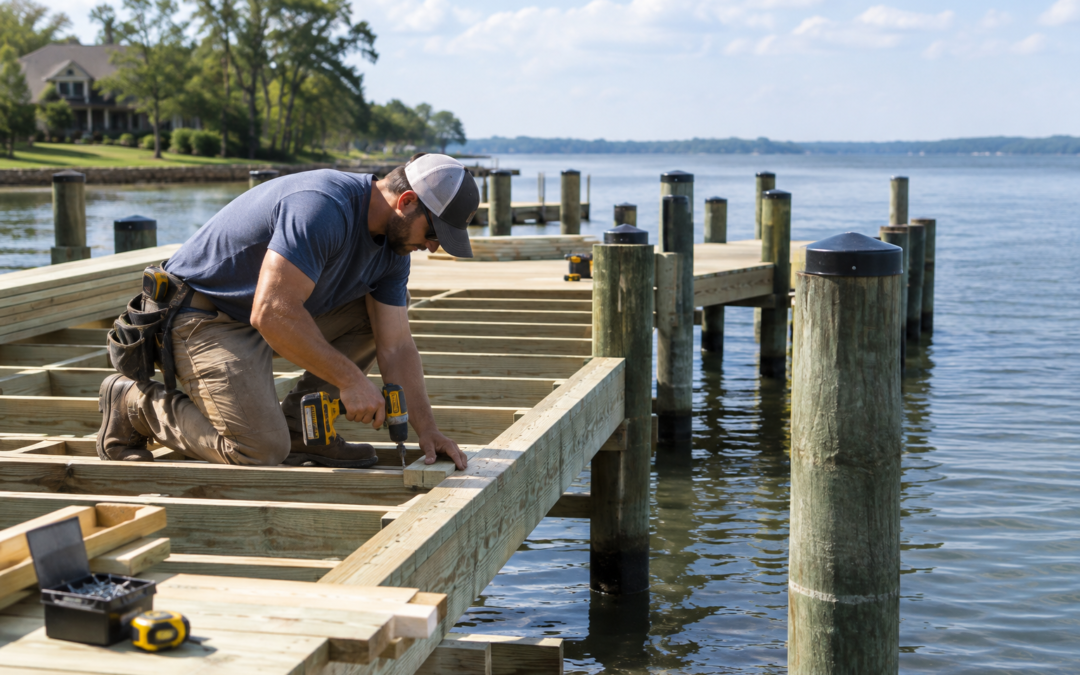
Fixed pile docks are built on pilings driven into the river bottom, with framing and decking above, and they offer the most solid and familiar feel underfoot. They perform best where the river does not swing dramatically, because a fixed deck sits at one height no matter what the water does. Where flooding is a concern, the deck elevation and the strength of every connection between piling, beam, and board become the central design questions.
Floating docks rest on flotation and are held in place by guide piles that allow vertical movement, so the deck rises and falls with the river and stays at a comfortable height for stepping into a boat or kayak. For many Bogue Falaya properties, that adaptability is a major advantage. Our guide to floating versus fixed docks goes deeper into how the two approaches compare.
Hybrid designs pair a fixed walkway near the bank with a floating platform at the water’s edge, giving you a firm connection to shore and an adjustable surface where you actually board a vessel. A covered dock or boathouse adds a roof for shade and protection, but the roof adds weight and wind load, and the structure also has to be designed for flood conditions, so both questions need to be answered together. Our dock builder page describes each of these configurations in more detail.
Materials and Hardware That Survive Life on a River
Material choices determine both how long a river dock lasts and how much time you will spend maintaining it. Pressure treated timber remains the standard for pilings and framing, but it needs a marine or ground contact rating suited to constant wet exposure, because lumber sold for ordinary residential decks will rot far sooner than most owners expect.
Composite decking deserves serious consideration along the Bogue Falaya in particular. The tree cover that makes these banks so beautiful also keeps surfaces shaded and damp, which encourages algae and mildew on wood, and composite boards resist that growth while requiring very little upkeep. The higher upfront cost is often offset over the years by the time and money not spent on sealing, scrubbing, and replacing boards.
Hardware is where many otherwise good docks quietly fail. Connections endure constant stress from current, debris, and shifting water levels, so hot dipped galvanized or stainless steel fasteners and brackets are essential, and a single failed bolt can allow a much larger structural problem to develop. If the design includes floating sections, the quality of the flotation matters just as much, since foam filled, rotationally molded floats resist punctures and water absorption far better than inexpensive alternatives and last considerably longer.
Designing for Floods, Debris, and the Day After
A dock on the Bogue Falaya should be designed with high water in mind, though that does not mean making it indestructible. The goal is to make intelligent choices so that a flood becomes a cleanup rather than a total loss. For floating docks, that means guide piles tall enough to keep the dock captured when the river is at its highest, and for fixed docks it means strong, well fastened connections between pilings, beams, and decking so that debris striking the structure does not pull it apart.
Electrical components, lighting, and cleats deserve the same thought, since anything mounted low or poorly sealed is vulnerable once the water rises. It also helps to keep the dock clear of loose items that could float away or snag on the structure when the river comes up.
The day after a high water event matters as much as the design itself. Before using the dock again, walk it carefully and look for shifted pilings, loosened hardware, damaged boards, and debris lodged in the framing. A small problem found early is far cheaper and safer to fix than one discovered when it finally gives way underfoot.

Permitting a Dock in Covington
Building over a river requires permits, and the approval process usually takes longer than the construction itself. Structures in navigable waters generally need authorization from the Army Corps of Engineers under Section 10 of the Rivers and Harbors Act, and many standard residential docks qualify for a streamlined Nationwide Permit rather than a full individual review. Where a project falls within Louisiana’s coastal zone, a coastal use permit may also be required, and some stretches of river can carry additional state review, so it is worth confirming exactly what applies to your stretch of the Bogue Falaya before the design is finalized.
Local rules matter as well. St. Tammany Parish and the City of Covington may impose building and floodplain requirements that affect the size, placement, and construction of a dock, and those requirements are far easier to satisfy when they are considered at the start than when they are discovered after the plans are drawn. If your property sits in a subdivision, review the HOA documents or deed restrictions too, since some communities limit dock size or style.
A straightforward residential dock commonly takes 60 to 120 days to permit, and larger or covered structures take longer. Our permitting process page explains how Lamulle prepares and manages these applications so that they are complete the first time they are submitted.
What Drives the Cost of a Covington Dock
Dock pricing always comes back to the specifics of the site. Length and width set the baseline, because every added foot of structure brings more pilings, framing, and decking. The dock type changes the equation as well, since a floating dock adds flotation and guide piles while a fixed dock requires deeper, more numerous pilings.
Material grade, a roof, electrical service, and site access then layer on additional cost. A steep, wooded bank can make it harder to get equipment to the water, and that difficulty shows up in labor and mobilization. Because so many of these variables are particular to a single lot, a site visit is the only reliable way to arrive at a number you can trust.
How to Choose a Dock Builder for a River Property
A contractor who builds excellent decks is not automatically equipped to build over moving water. The most important quality to look for is river experience, because a builder who has worked the Bogue Falaya and neighboring rivers understands water level swings, debris loads, and bank conditions in ways that a lake only contractor may not.
Beyond that, ask for proof of a Louisiana contractor license and appropriate liability and workers compensation coverage, and make sure the builder will prepare and manage the permit applications on your behalf. The written proposal should spell out the dock type, piling count, material grades, and hardware, and a confident builder will gladly share references from completed river projects. You can learn more about how we work on the river on our Bogue Falaya marine construction page.
Build a Dock That Belongs on the River
A dock designed for the Bogue Falaya‘s changing water, steady current, and flood risk will serve a property for decades, while one built as though the river were a lake tends to cost more in repairs than it saved at the start. Lamulle Construction has spent generations building waterfront structures across the Lake Pontchartrain region, and every project begins with a site visit and an honest conversation about what your riverfront needs.
Contact Lamulle Construction to schedule your Covington dock assessment.