Every spring along the Gulf Coast, waterfront property owners face the same window of opportunity: the weeks between the last cold front and the first named storm. It is a short stretch of calm that does not last. Once June arrives, contractor schedules fill up, material lead times stretch, and the pressure to make decisions increases with every tropical weather outlook.
The smartest thing you can do with that window is walk your dock and look at it honestly. Not a quick glance from the yard, but a real inspection covering pilings, decking, hardware, connections, and anything attached to the structure. Problems that seem minor in April have a way of becoming expensive after a storm passes through.
This guide walks you through exactly what to check, what warning signs to take seriously, and when it makes sense to call in a professional before hurricane season begins.
What Should You Check on a Dock Before Hurricane Season?
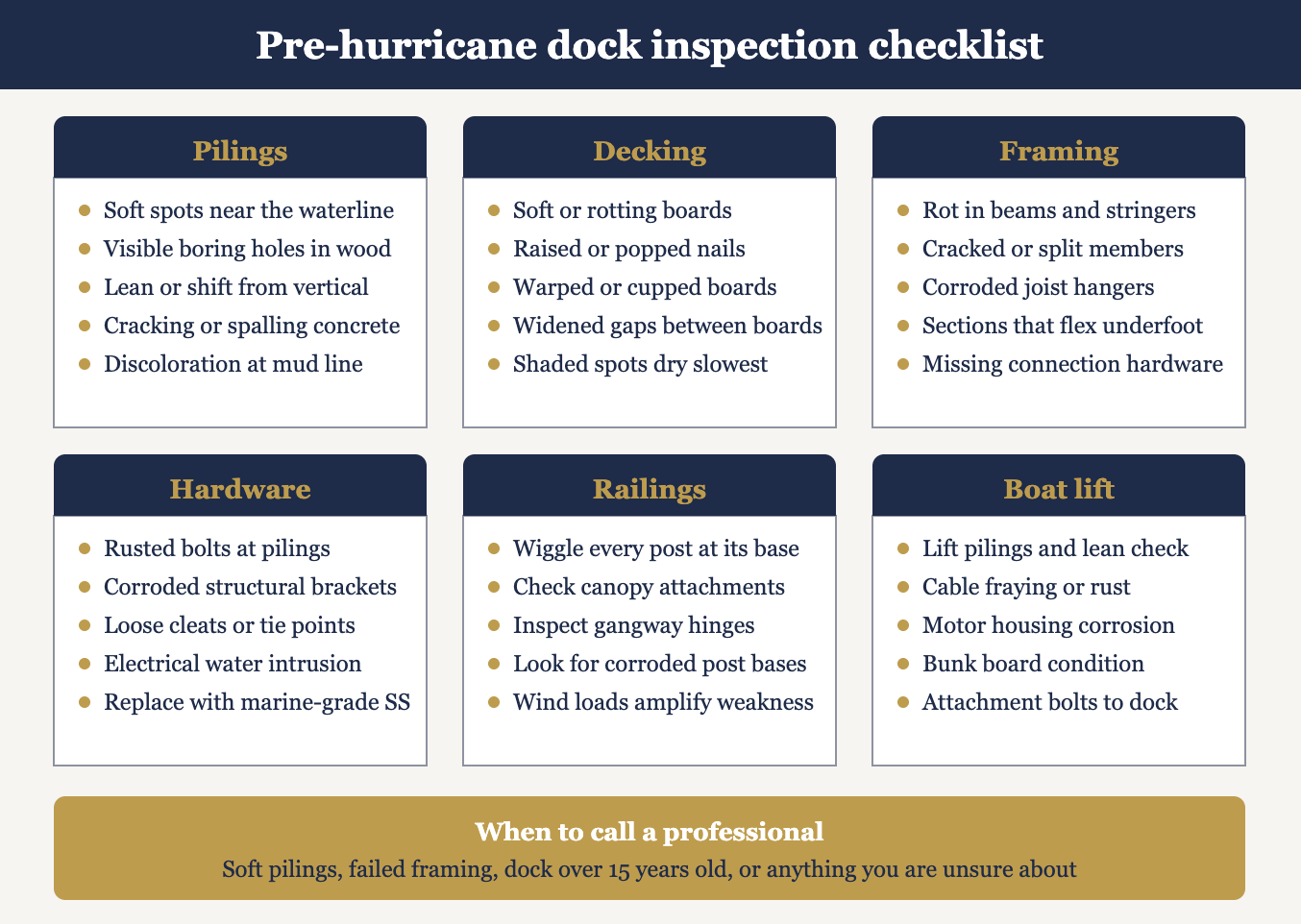
A pre-hurricane dock inspection covers six key areas: pilings, decking, framing and joists, hardware and fasteners, railings and accessories, and any attached structures like boat lifts or covered platforms. The goal is to identify rot, corrosion, shifting, or structural weakness before wind and storm surge put those weaknesses to the test. Catching problems in April is far less expensive than repairing storm damage in August.
Start With the Pilings
Pilings are the foundation of your dock. Everything else depends on them holding position under load, and storm surge and wave action will test that in ways normal use never does.
Walk around each piling and look for:
- Soft spots or sponginess near the waterline, which is often the first sign of wood rot or marine borer activity
- Visible boring holes in treated wood, indicating shipworm or other wood-boring organisms have compromised the interior
- Cracking or spalling on concrete pilings, especially horizontal cracks that suggest bending stress
- Lean or shift from vertical, because even a few degrees of lean can become a serious problem when surge loads are applied
- Discoloration or staining that suggests deterioration below the waterline
The area just below the waterline and at the mud line are the two most vulnerable zones on any piling. If you can, check those areas during low tide when more of the piling is exposed. For a deeper look at piling materials and what affects their lifespan, our dock pilings guide covers the tradeoffs between wood, concrete, and composite options.
Inspect the Decking and Surface
Surface boards take a beating from sun, rain, foot traffic, and humidity year-round. Before hurricane season, you want a deck that is structurally sound, not just cosmetically acceptable.
Check for:
- Boards that are soft, punky, or visibly rotting, particularly around fastener holes where moisture penetrates
- Raised fasteners or popped nails that create trip hazards and indicate wood movement underneath
- Warped or cupped boards that have pulled away from joists and no longer carry load properly
- Gaps that have widened beyond normal, which often signals the framing underneath has shifted or shrunk
Pay special attention to areas that stay in shade or hold standing water after rain. Those spots dry out slowest and deteriorate fastest.
Check the Framing and Substructure
The framing, including the beams, stringers, and joists connecting your decking to the pilings, carries the loads that storms will amplify. Damaged framing is harder to spot than rotted decking but far more serious.
Get low and look under the deck if you can. You are looking for:
- Rot in cross-members, especially where they connect to pilings or each other
- Cracked or split beams that suggest overloading or long-term stress
- Corroded or missing hardware at connection points
- Any section of framing that flexes, bounces, or feels soft underfoot
If the framing has failed, surface repairs will not hold in a storm. The structure needs to be addressed from the bottom up. This is also the right time to evaluate whether your dock is a candidate for dock repair or whether the scale of issues points toward a fuller rebuild.
Hardware, Fasteners, and Connections
In saltwater and brackish environments like Lake Pontchartrain, Madisonville, and the Mississippi Gulf Coast, hardware corrodes faster than most property owners expect. Saltwater is relentless on metal, and every fastener, bracket, and connector is a potential failure point when storm forces arrive.
Go through and check:
- Bolts and lag screws at piling connections, looking for rust staining, corrosion, or heads that have pulled through the wood
- Joist hangers and structural brackets, which should be tight, rust-free, and fully seated
- Cleats and dock accessories, because anything that will hold a line during a storm needs to be anchored into sound material, not rotted wood or a corroded base
- Electrical connections if your dock has lighting or shore power, since water intrusion into electrical systems is a fire risk and should be inspected before storm season
Replace corroded hardware with marine-grade stainless steel or hot-dipped galvanized options. Standard hardware from a home improvement store will not hold up in a coastal environment and should not be used on structural connections.
Railings, Walkways, and Attached Structures
Anything that extends above the deck surface catches wind. During a hurricane, railings, overhead structures, and canopies act like sails, and if they are not solidly anchored, they become projectiles.
Check every railing post at its base. Wiggle each one. Any movement at the connection point is a problem. Look for:
- Loose or wobbling posts where the base connection has corroded or rotted
- Railings that have been repaired with inadequate fasteners
- Covered structures or canopies with loose roofing, unsecured panels, or corroded attachment hardware
- Any walkway or gangway connecting the dock to shore, because the hinge and connection hardware at both ends takes significant load during surge events
If your dock includes a covered boat slip or an overhead structure, the walkway and bridge page covers structural connection considerations worth reviewing.
Boat Lift Inspection
If your dock has a boat lift, the lift itself warrants a separate look. The lift structure, including its pilings, bunks, cables, and motor, takes on significant stress during storms, and a failed lift can damage both the vessel and the dock.
Before hurricane season, check:
- Lift pilings for the same rot, lean, and corrosion issues as dock pilings
- Cables for fraying, kinking, or rust
- The motor housing for water intrusion and corrosion
- Bunk boards for wear or splitting
- All bolts and connections where the lift attaches to the dock structure
For more on what good lift maintenance looks like year-round, how to maintain your boat lift is a useful reference before storm season inspections.
When to Call a Professional
Some things on this list you can assess yourself with a careful eye and a willingness to get close. Others require trained judgment. Consider calling a professional marine contractor when:
- You find soft or bored pilings, since the extent of the damage is hard to assess without experience
- The framing under your deck shows rot or failure at connection points
- Your dock is more than 15 years old and has not had a professional inspection in the last several years
- You are planning to sell your waterfront property and need a documented condition report
- You simply are not sure what you are looking at
The value of a pre-season inspection is that problems found in April can be scheduled and repaired properly. Problems found after a storm are addressed under pressure, often at higher cost, and sometimes with fewer material options available.
What to Do With What You Find
After your inspection, sort what you found into three categories:
- Fix now: anything structural, any hardware failure at a connection point, any piling with active rot at or below the waterline
- Monitor this season: surface wear that is not yet structural, minor hardware corrosion that has not reached the base material
- Plan for next year: cosmetic issues, minor surface boards, accessories that are worn but functional
Document everything with photographs. Date them. Insurance companies consistently request evidence of pre-storm condition when claims are filed, and having a clear record of your dock’s condition before storm season protects you if you need to make a claim.

Plan Ahead: Contractor Schedules Fill Quickly
Lamulle Construction has been working on docks, piers, and waterfront structures along the Louisiana and Mississippi Gulf Coast since the company was founded after World War II. If your pre-season inspection turns up questions you are not sure how to answer, contact us and we can take a look.