Slidell sits at the northeast corner of Lake Pontchartrain, where the lake meets the Rigolets and a network of tidal creeks, bayous, and canals that define one of the most active waterfront communities on the Gulf Coast. The area draws boaters, fishermen, and waterfront property owners who value direct water access. It also delivers the full range of coastal erosion pressure: tidal fluctuation, storm surge exposure, brackish water chemistry, and the steady wake of vessels moving through Bayou Bonfouca, Lake Catherine, and the surrounding waterways.
For property owners in Slidell, seawalls and bulkheads are the front line of defense. When they are in good shape, they are invisible. When they start to fail, the consequences move fast. A compromised seawall does not just look bad. It puts your shoreline, your dock, your yard, and potentially your home’s foundation at risk.
The best time to catch seawall and bulkhead problems is early, before a repair becomes a replacement. Lamulle Construction serves the Slidell area and the broader Lake Pontchartrain shoreline, and this guide covers what to watch for before small issues become expensive ones.
What Does Seawall and Bulkhead Failure Actually Look Like in Slidell?
Seawall and bulkhead failure in Slidell typically looks like a gradual process that accelerates once it crosses a threshold. Early signs are subtle: a slight lean in the wall, minor cracking, soil that seems slightly softer behind the structure. Late-stage failure is unmistakable: collapsed sections, large voids, undermined dock pilings, and visible soil loss along the shoreline. The window between early warning and active failure can be as short as one storm season.
Warning Sign 1 — The Wall Is Bowing or Leaning
A vertical wall that is no longer vertical has a problem. Bowing toward the water means the soil pressure behind the wall is exceeding what the structure was designed to resist. This happens when the anchor system holding the wall in place has corroded or pulled free, when the soil behind the wall becomes saturated and heavy after heavy rain, or when the wall’s structural integrity has been compromised over time.
In Slidell’s tidal environment, soil behind a seawall is frequently wet. A wall that handles that loading when new can start to bow as anchors corrode and the material itself ages. A bow of even a few inches is worth having professionally assessed. By the time a wall is visibly leaning from the water, the anchor system may have already failed.
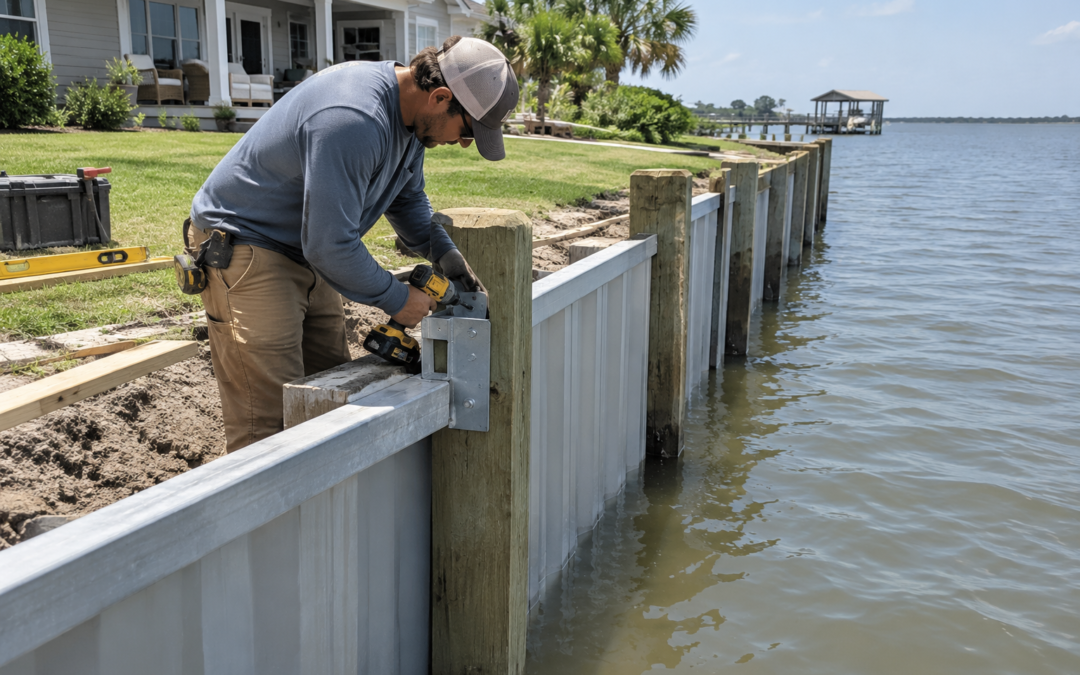
Our seawall repair team can often stabilize a bowing wall with helical tie-back anchors driven into stable soil behind the structure, avoiding full replacement if the wall material itself is still sound.
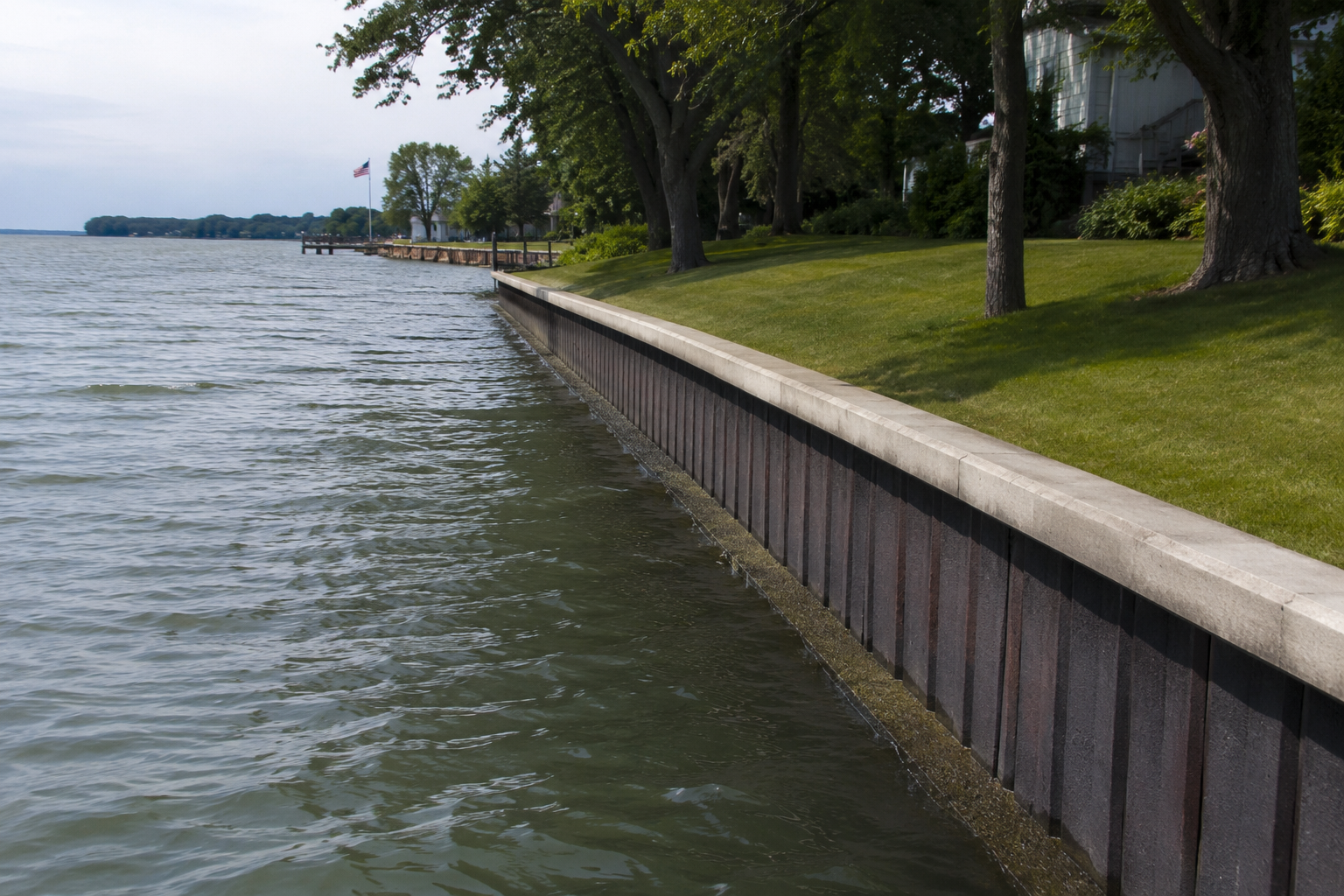
Warning Sign 2 — Cracks in the Wall Face
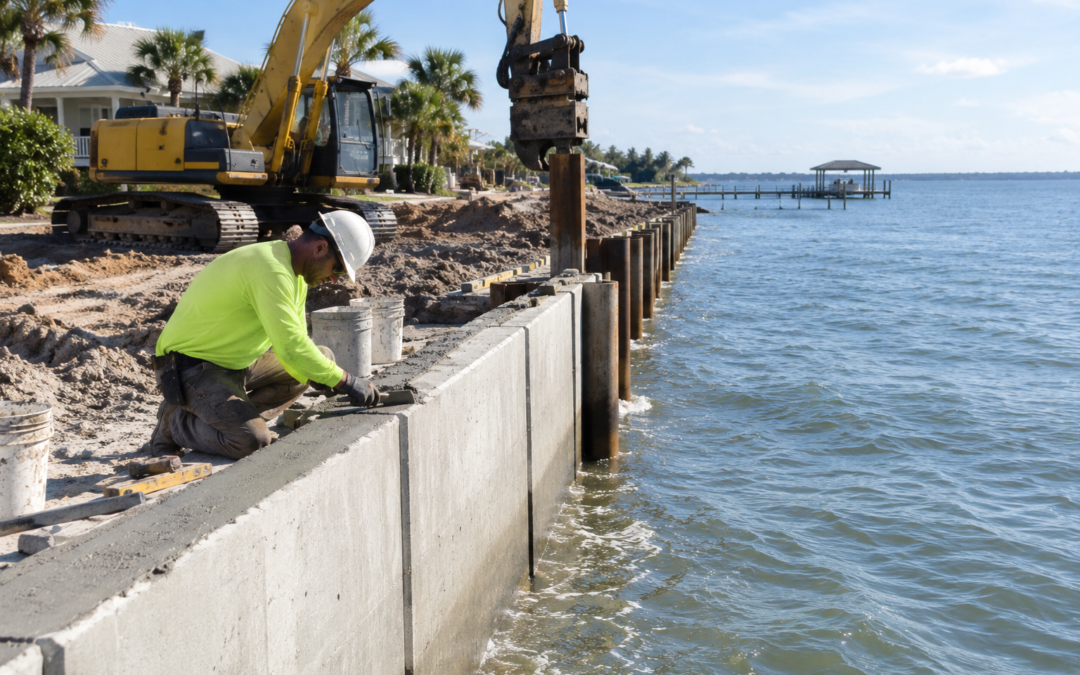
Not all cracks are equal. Hairline surface cracks in concrete seawalls are common and often cosmetic. Cracks that run through the full depth of the panel, that are growing over time, or that are accompanied by rust staining are a different matter entirely.
Rust staining on a concrete seawall tells you that the steel reinforcement inside the panel is corroding. Corroding steel expands, and that expansion cracks the concrete from the inside. Once this process begins, it accelerates. The crack allows more water to reach the rebar, the corrosion spreads, and the panel loses structural integrity progressively.
Cracks in vinyl or fiberglass panels are less common but significant when they occur. A cracked panel allows soil to wash through, which leads to the voids and sinkholes described below. Any crack that runs the full height of a panel or that has visible soil movement through it requires immediate attention.
Warning Sign 3 — Voids or Sinkholes Behind the Wall
If you notice depressions, soft spots, or small sinkholes forming in the ground behind your seawall or bulkhead, soil is moving. It is washing through gaps in the wall, through failed joints between panels, or under the bottom of a wall that has shifted. This is one of the most serious warning signs because it means the failure is already underway.
Slidell’s soil is predominantly soft clay and silt. Once it starts moving through a compromised wall, the process is self-accelerating: the void grows, the wall loses the soil support it needs, and the next storm event can turn a small problem into a collapsed section. Check the ground behind your wall after every significant rain event and after any storm.

Warning Sign 4 — Erosion Around the Base of the Wall
Scour at the base of a seawall is common in tidal environments. The back-and-forth movement of tidal water accelerates erosion at the toe of the wall, where the structure meets the bottom. If you can see the base of your wall is being undermined, or if the wall has started to tilt forward at the bottom, the foundation is failing.
This type of failure is particularly relevant for Slidell properties on active tidal waterways. The Rigolets and the tidal creeks feeding into Lake Pontchartrain from the north shore carry significant water movement. Scour protection at the base of a seawall, typically through rock or riprap placement, is an important part of any repair in this environment.
Warning Sign 5 — Rust Staining and Corrosion on Metal Components
Most seawall and bulkhead systems include metal components: tie-back rods, walers, cap hardware, or in the case of steel sheet pile walls, the wall material itself. In Slidell’s brackish water environment, these components are under constant corrosion pressure.
Rust staining on the wall face from hardware above, orange streaking from tie-back anchor points, or visible pitting on any metal components are signs that the hardware is corroding. Corroded tie-back rods are a particular concern because they are the component holding the wall against soil pressure. A wall with failed tie-backs will eventually bow and then fail, often without much additional warning.
Warning Sign 6 — Settlement of Your Dock or Adjacent Structures
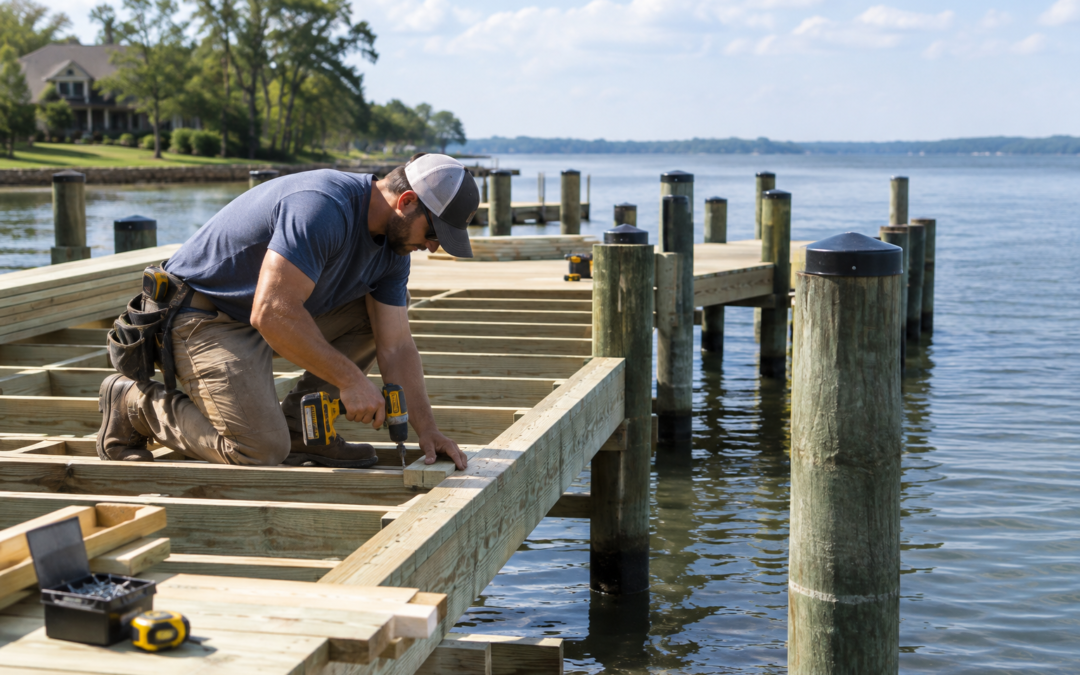
Your dock, deck, or any structures built near the shoreline depend on stable soil beneath them. If your seawall is failing and soil is moving, the first place you may notice it is in the structures built on that soil. Dock pilings that were perfectly plumb are now leaning. Deck boards that were level now have a noticeable pitch. Steps leading down to the water are pulling away from the house.
These are late-stage warnings that soil movement is already significant. If you are seeing settlement in your dock or yard structures, the seawall investigation should be urgent. See our Slidell marine construction page for more on how we approach these projects on the north shore.
Warning Sign 7 — Water Coming Through the Wall
Weep holes are intentional drainage points designed into seawalls and bulkheads to relieve hydrostatic pressure. Water draining through a weep hole is normal and expected. Water pushing through cracks, panel joints, or gaps that were not designed as drainage points is not.
If you see water seeping through your wall in locations that are not designated weep holes, the wall’s barrier function is compromised. Soil particles washing through with that water confirm that active erosion is underway behind the wall.
What to Do When You Spot These Warning Signs
The worst thing you can do when you spot a warning sign is wait. Seawall and bulkhead problems do not stabilize on their own. Every tide cycle, every boat wake, every rain event works against a compromised structure. The gap between a repairable problem and a replacement-required problem can close in a single storm season.
When you spot any of the warning signs above, the right move is a professional inspection. A qualified marine contractor can assess the full condition of the structure, identify the cause of the failure, and give you an honest picture of whether repair or replacement is the right path forward.
Repair is the right answer when the damage is localized and the core structure is still sound. Full seawall replacement makes sense when the wall has reached the end of its service life, when deterioration is widespread, or when the original material is no longer appropriate for current conditions.
Seawall Repair Options for Slidell Properties
When repair is the right path, the specific approach depends on the type of failure:
- Tie-back anchor installation. For bowing walls where the original anchor system has failed, new helical tie-back anchors can be driven into stable soil behind the wall to restore resistance to soil pressure. This is often the most cost-effective way to extend the life of an otherwise sound wall.
- Panel patching and joint sealing. Isolated cracks and failed joints in concrete or vinyl walls can be sealed to restore the wall’s barrier function and stop soil migration. This is appropriate for localized damage on structures that are otherwise in good condition.
- Scour protection. For walls being undermined at the base by tidal scour, placing riprap or rock at the toe of the wall stabilizes the foundation and stops the undermining process.
- Cap replacement. The cap is the top section of the wall, and it often deteriorates before the sheet piling below it. Replacing a deteriorated cap while leaving the structural wall in place is a targeted repair that extends the wall’s service life at a fraction of replacement cost.